

China's 19-seat electric aircraft CE-25A completes first piloted flight
COMAC's 10-tonne electric passenger aircraft CE-25A successfully made its first piloted flight on Nov. 14 in Binzhou, Shandong, with two pilots and a flight-test engineer on board.
· 1 min read
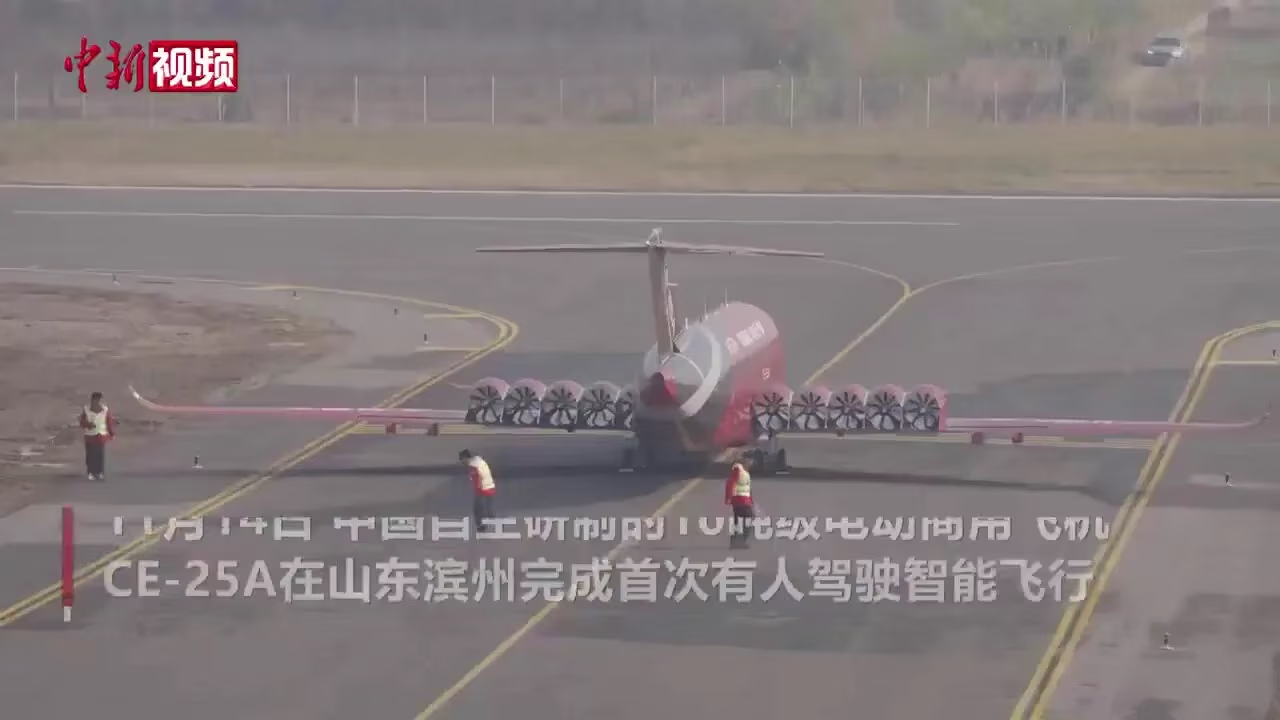
The Commercial Aircraft Corporation of China (COMAC) announced that the CE-25A, a 10-tonne electric passenger aircraft developed independently in the country, successfully completed its first piloted flight on Saturday, Nov. 14, in Binzhou, Shandong Province. Two pilots and a flight-test engineer were on board.
According to COMAC, the aircraft performed normally throughout the flight and all key performance indicators met expectations. The flight is regarded as an important step in the CE-25A's development.
Aircraft specifications
The CE-25A is designed for short-distance commercial flights between cities and can carry up to 19 passengers. Its maximum takeoff weight is 10 tonnes, cruising speed 300 kilometers per hour, cruising altitude about 2,400 meters and range about 400 kilometers. Instead of conventional jet or turboprop engines, the aircraft uses an electrically driven, distributed ducted-fan propulsion system integrated into its wings.
COMAC's first electric commercial aircraft, the CE-25A was developed in collaboration with battery manufacturer CATL, Shanghai Jiao Tong University and other partners.
Background
The CE-25A made its first unmanned autonomous flight on Feb. 2, 2026. Since then it has completed 19 unmanned autonomous flight validations before moving on to piloted flight.
The project has also entered the certification process: the Civil Aviation Administration of China (CAAC) has accepted COMAC's type certificate application. However, the aircraft has not yet received approval for commercial operations.
Technology guides
- How to view grades and absences on e-OkulSign in to the e-Okul Parent Information System with e-Devlet or a parent password, select the student, and open the grades or absences menu. Students can also check their own records.
- How to get a student certificate from e-DevletLog in to e-Devlet Kapısı (the Turkish e-Government Gateway), search for “öğrenci belgesi” (student certificate) and open the relevant service. The document is generated electronically; check the receiving institution's acceptance rules.
- How to check planned power outages and what are your rights during an outage?You can check planned outages on your regional electricity distribution company's website, mobile app or call center. The regulator for outage and quality rights is the Energy Market Regulatory Authority (EPDK).


Comments
Sign in to comment.